


Best Cities to Study in Italy: Milan vs. Rome
A Strategic Guide for International Students
Navigating the Italian Academic Landscape
Italy has solidified its status as a premier global educational hub, attracting thousands of international students annually who seek a synthesis of rigorous academic tradition and profound cultural heritage.
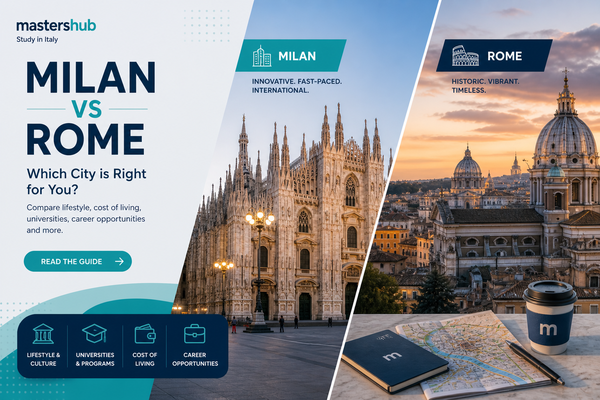
However, from the perspective of a Senior International Education Consultant, Italy must not be viewed as a monolithic destination. The student experience is sharply bifurcated between the northern economic engine, centered in Milan, and the profound historical and diplomatic legacy of the capital, Rome.
For the prospective international student, the question of “where to study in Italy“ is not merely a matter of geographical preference but a critical strategic decision. The choice of city acts as a catalyst for one’s career trajectory, aligning academic rigor with specific regional industry ties, socioeconomic realities, and urban “vibes.”
Success in the Italian market requires more than just enrolling in a high-ranking program; it requires a calculated match between the student’s professional ambitions and the local environment’s capacity for human capital development. This guide provides a high-level roadmap to help students navigate the choice between Italy’s premier academic destinations, ensuring their educational investment yields the highest possible return on both personal growth and professional mobility.
The Dual Pillars of Italian Education: Vibe and Atmosphere
In the field of academic strategy, the “atmosphere” of a city is recognized as a fundamental pillar of cultural integration and academic success. A student’s daily environment dictates their networking opportunities, psychological resilience, and overall capacity for productivity. In Italy, this atmosphere is divided into two distinct archetypes: modern efficiency and historical immersion.
Milan: The Northern Economic Powerhouse
Milan is the undisputed heart of Italy’s industrial and financial sectors. Hosting approximately 140,000 university students, it is a magnet for those specifically seeking English-taught programs and global industry connectivity. The city projects an aura of modern efficiency; its skyline, characterized by contemporary skyscrapers and wide, bustling boulevards, reflects a forward-looking mindset.
For the international student, Milanese life mimics the high-energy environment of the corporate world. The psychological impact is one of constant stimulation. This is a city that moves at “career speed”, where the urban fabric encourages a disciplined, future-oriented lifestyle. Milan is not just a place to study; it is a professional training ground where the “vibe” is one of ambition and modern innovation.
Rome: The Historical Capital and Cultural Nexus
In contrast, Rome—home to roughly 200,000 students—offers an experience defined by “total cultural immersion.” In the capital, history is not a subject found only in books; it is the very environment where daily life unfolds. Classrooms are often housed within centuries-old palazzos adjacent to the Colosseum, and libraries serve as repositories of millennia of human knowledge.
The atmosphere in Rome encourages a different kind of development: depth over speed. The pace is more reflective, requiring students to navigate a “living museum.” While Milan is about the future, Rome is about the continuity of civilization. For a foreign student, this immersion provides a unique historical perspective and a profound sense of personal growth, though it requires a higher degree of adaptability to the city’s organic and occasionally chaotic urban rhythm.
The “So What?” Layer: Strategic Implications
The choice between these atmospheres has significant psychological and professional consequences. If your Key Performance Indicator (KPI) for study abroad is immediate integration into the “global boardroom,” Milan’s structured and high-stakes environment is the only logical choice. It fosters a mindset of precision and corporate readiness.
Conversely, if your goal is to develop a “global stage” persona—grounded in diplomacy, history, and cultural nuances—Rome’s immersive environment is superior.
Milan prepares you to compete in the market; Rome prepares you to understand the world that the market exists within.
Academic Excellence and Institutional Specialization
When evaluating the “best cities to study in Italy,” the institutional reputation of a university must be analyzed in the context of its regional economic ties. Italian higher education is characterized by distinct poles of excellence that correlate directly with the city’s primary industries.
The Technical and Business Pillar: Milan
Milanese institutions are designed for the pragmatist. They emphasize “job readiness” and maintain aggressive partnerships with multinational firms.
-
- Politecnico di Milano: A global leader in architecture, industrial design, and engineering. The campuses are specialized for “hands-on work,” providing students with the technical proficiency required to enter high-level manufacturing and design sectors. A student’s portfolio here is built on practical application and technical innovation.
- Bocconi University: The gold standard for economics, finance, and management in Southern Europe. Bocconi is renowned for its elite networking circles and its focus on management degrees that attract young professionals globally. The institution functions as a direct pipeline into the European financial sector.
Roman institutions excel in fields that require in-depth analysis, historical context, and governance understanding.
-
- Sapienza University of Rome: One of Europe’s oldest and most prestigious institutions, Sapienza is a powerhouse in medicine, archaeology, and philosophy. Its faculties are integrated into the historic center, allowing students access to unique archives and research opportunities tied to the Mediterranean basin.
- LUISS University: Specialized in political science, law, and international relations. LUISS provides students with direct exposure to public institutions and diplomatic missions, emphasizing the “soft power” skills required for careers in governance.
The “So What?” Layer: Long-Term Career ROI The academic specialization of each city dictates your post-graduation value proposition. A degree from Milan (Politecnico or Bocconi) is a strategic asset for those entering “cutthroat job markets” where technical skills and corporate networking are the primary currencies. Over a 5-10 year horizon, a Milanese education often leads to leadership roles in multinational corporations in hubs like London, New York, or Frankfurt.
In contrast, a degree from Rome (Sapienza or LUISS) serves as a foundation for “academic or diplomatic careers.” The value lies in an analytical depth and an understanding of public institutions that are essential for roles in the public sector, NGOs, or international missions in Brussels and Geneva. Your choice defines whether your professional currency will be “market utility” or “institutional influence.”
Economic Reality: A Comparative Analysis of Costs
Financial planning is the cornerstone of a successful international study experience. As a consultant, I advise students to look beyond tuition fees and evaluate the total “cost of living” as a variable that affects their quality of life and academic focus.
Financial Comparison: Milan vs. Rome
| Rank (Italy) | University | Global Rank (QS) | Notable Subject Strength |
|---|---|---|---|
| 1 | Politecnico di Milano | 149 | Art & Design (6th), Architecture (7th), Engineering |
| 2 | Scuola Normale Superiore di Pisa | 167 | Research Citations (18th in the world), Sciences |
| 3 | Scuola Superiore Sant'Anna Pisa | 175 | Applied Sciences, Agricultural Research |
| 4 | Università di Bologna (UNIBO) | 180 | Law, Humanities, Social Sciences |
| 5 | Sapienza - Università di Roma | 217 | Classics & Ancient History, Physics |
Risk Mitigation and Fund Allocation While both cities require a substantial budget, Rome is objectively the “cheapest city to study in Italy” between the two primary hubs. The lower cost of accommodation and transit in the capital “stretches funds further,” allowing international students to allocate more resources toward cultural exploration and professional networking.
Furthermore, the availability of public scholarships at Sapienza and LUISS acts as a critical “risk mitigation” factor for students from emerging markets, lowering the financial barrier to entry for a high-quality European degree.
Milan, conversely, requires a higher initial capital expenditure (CAPEX). This should be viewed as a “premium” paid for immediate proximity to Italy’s industrial drive. The higher cost of living in Milan often forces a more disciplined, campus-centric, and professionalized lifestyle, which can be beneficial for students focused on high-speed career entry.
Strategic time management is essential for student productivity. The ability to move efficiently between campus, housing, and social/professional hubs directly impacts a student’s “Daily Operational Efficiency.”
Milan’s Infrastructure of Productivity
Milan possesses a highly efficient metro system, allowing students to reach the city center within 20–30 minutes. This reliability supports a high-productivity lifestyle where time is managed with precision.
Additionally, Milan’s Malpensa Airport is a superior hub for international connectivity, offering frequent low-cost flights across Europe. For the student, this means that weekend networking across major European cities is both logistically and financially feasible, expanding their global professional footprint.
Rome’s Compact Complexity
Rome relies more heavily on an extensive network of buses and trams, as its metro system is limited to two main lines (A and B). While the historic center is compact and walkable—which can shorten trips between humanities faculties—commutes are frequently hampered by city traffic. Rome is well-connected via Fiumicino Airport, which provides direct routes to other southern European hubs like Madrid or Barcelona, but the daily internal commute requires more “strategic patience” and flexibility than the Milanese system.
The “So What?” Layer: Time as an Asset
For an international student, time is the most scarce asset. Milan’s infrastructure allows for the “maximization of the hour,” supporting a lifestyle where the commute is predictable and minimized. Rome’s system, while culturally rich, requires a lifestyle adjustment where “the journey” becomes part of the day. Choosing Milan is a choice for operational reliability; choosing Rome is a choice for a more traditional, if occasionally less efficient, urban experience.
The Student Scene and Career Trajectories
The integration of social life and professional networking is where a student’s journey transitions from academic preparation to professional reality. In Italy, these two spheres are inextricably linked.
-
- Milan (15% International Students): The social scene is dominated by professional events, fashion weeks, and design fairs. Socializing often happens in the sleek bars of the Navigli district or during campus festivals. Networking here is overt, industry-focused, and “driven.” It is an environment where you are as likely to meet a future employer as you are a classmate.
- Rome (20% International Students): Rome offers a more diverse social fabric rooted in cultural exchange. The scene is centered in traditional neighborhoods like Trastevere and includes “free” cultural offerings like opera or strolls through historic plazas. Networking in Rome is more subtle; it is a “who you know” culture where connections are forged over dinner and long-form discussion, reflecting the diplomatic and governmental nature of the city.
Post-Graduation Prospects and Unemployment Realities
-
- Milan Prospects: The city is the gateway to roles in fashion, finance, and tech, with alumni from Politecnico and Bocconi being recruited by giants like Armani or Goldman Sachs. While youth unemployment in Milan hovers near 20%, this statistic is significantly mitigated by a high volume of professional internships that frequently transition into permanent career bridges.
- Rome Prospects: Career paths in the capital are inextricably linked to the public sector, the Vatican, NGOs, and various EU and UN offices (such as the FAO). Although youth unemployment in Rome can top 25%, the city’s unique “diplomatic networks” offer graduates a global exit strategy into international relations and public administration.
The “So What?” Layer: The Internship vs. The Network
In Milan, the “permanent career bridge” is the internship. The private sector’s focus on technical skills and immediate utility makes Milan the ideal location for those seeking a fast ROI and private-sector dominance. In Rome, the career path is built on “relational capital.” The social environment of Rome—the plazas and traditional spots—is not just for leisure; it is where the critical connections for a diplomatic or governmental career are solidified.
Frequently Asked Questions: Studying in Milan vs Rome
Explore the key differences between studying in Milan and Rome, including cost of living, career opportunities, universities and student lifestyle.
What is the best city to study in Italy?
The best city to study in Italy depends on your academic focus and career goals. Milan is the leading hub for Engineering, Business and Fashion, thanks to its strong industrial economy and top universities like Bocconi University and Politecnico di Milano. Rome, on the other hand, excels in Humanities, Archaeology and Political Science, offering a unique academic environment through institutions like Sapienza University of Rome and LUISS University.
What is the cheapest city to study in Italy?
Among major cities, Rome is generally cheaper than Milan for students. Monthly living costs can be about 200€ lower, especially for accommodation (500€–700€ in Rome vs. 700€–900€ in Milan). Public transport is also more affordable, with annual passes around 250€ in Rome compared to 400€ in Milan. Additionally, public universities like Sapienza offer lower tuition fees starting from around 1,000€ per year.
Is Milan or Rome better for students?
Choosing between Milan or Rome for students depends on your priorities. Rome offers a higher level of international diversity, with around 20% international students and a rich cultural environment. Milan, while slightly less international, provides stronger career opportunities and direct connections with companies, making it ideal for students focused on employment after graduation.
What are the main career paths for graduates in Milan versus Rome?
Graduates in Milan typically pursue careers in the private sector, including finance, fashion and technology, working with companies like Goldman Sachs or Armani. In contrast, Rome graduates often enter the public, institutional or diplomatic sectors, with opportunities in ministries, NGOs, EU institutions, UN offices and organizations linked to the Vatican.
How do transport systems compare for students in Italy’s major cities?
Milan’s transport system is more modern and efficient, with a four-line metro network that allows students to commute in 20–30 minutes. Rome relies on a smaller metro system supported by buses and trams, which can be affected by traffic. However, Rome’s compact historic center makes it highly walkable, especially for students living near their university campus.
What should students prioritize when choosing between northern and central Italian universities?
Students should consider the trade-off between career speed and personal growth. Northern universities, especially in Milan, focus on technical skills, internships and industry connections. Central universities, particularly in Rome, emphasize cultural immersion, critical thinking and international relations. The right choice depends on your long-term academic and professional goals.
Expert Conclusion: Milan vs. Rome, Selecting Your Italian Destination
When selecting your destination, you must view Milan and Rome as “complementary poles” of Italian higher education. Neither is objectively superior; they serve different professional archetypes.
-
- Priority: Career Speed. If your goals involve technical mastery, finance, or immediate integration into the global corporate landscape, Milan is your only logical choice. It is the city for the innovator and the corporate strategist.
- Priority: Personal Growth Depth. If your goals involve the humanities, law, or diplomacy, and you value a deep cultural and historical foundation, Rome is the superior destination. It is the city for the thinker and the future diplomat.
Ultimately, your selection will shape your professional identity as much as your degree. we recommend students utilize the following resources for final institutional verification:
You may also be interested in:
Healthcare for International Students in Italy
Admissions to Private Universities in ItalyHealthcare for international students in Italy...
How much does it cost to live in Italy as a student
How much does it cost to live in Italy as an international student in 2026Living as an...
Universitaly 2026 Deadlines
Universitaly 2026 Deadlines for Non-EU Students The Universitaly 2026 deadlines for non-EU...
Pre-registration vs. enrollment
Pre-Enrollment vs Enrollment: Differences and Procedures in Italian...