


First- and Second-Level Master’s Degrees in Italy
Guide to postgraduate pathways in Italy
What are University Master’s Degrees
In Italy, beyond traditional degree programs, students can choose advanced postgraduate training pathways that allow them to acquire high-level, job-ready skills. Among these, the most widespread are First-Level University Master’s Degrees and Second-Level University Master’s Degrees, established in accordance with DM 509/1999 and DM 270/2004.
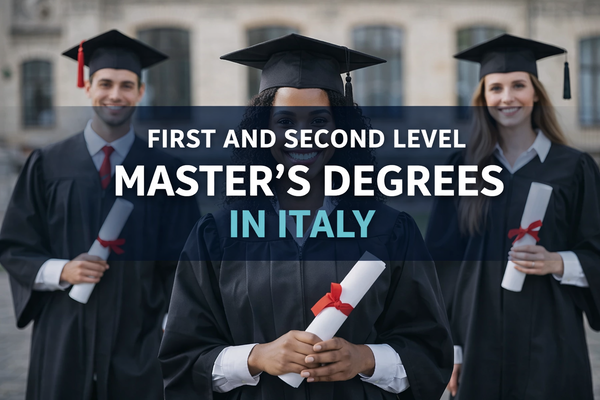
Universities and business schools offer them to recent graduates, young professionals, as well as to men and women with established careers who are interested in continuous professional development.
University Master’s Degrees are recognized by the MIUR and award an official academic qualification with legal validity, applicable both in the job market and in academic and public sectors. They should not be confused with so-called non-university “Master” programs (often misspelled as “Maters”), typically organized by private institutions or training companies, which–without explicit university accreditation—do not have legal value.
First-Level Master’s Degrees: features and requirements
A First-Level Master’s Degree is a professional postgraduate program designed for those who have obtained a Bachelor’s degree. Typically lasting one academic year, it focuses on practical and specialized skills, often combined with internships, project work, and hands-on experience. It should not be confused with a Master’s Degree (Laurea Magistrale), which is a second-cycle academic program (usually two years after the Bachelor’s degree) that deepens theoretical and scientific knowledge, provides access to PhD programs, and represents an official second-level qualification.
Key features:
- Duration: one academic year (at least 60 ECTS credits)
- Structure: lectures, workshops, project work, and company internships
- Objective: to provide job-oriented training for rapid entry into the labor market
- Target audience: recent graduates and young professionals
Main fields covered by First-Level Master’s Degrees:
- Economics and Management: business management, marketing, finance, human resources, entrepreneurship
- Engineering and Technology: civil engineering, IT, automation, renewable energy, artificial intelligence
- Social and Political Sciences: sociology, psychology, communication, political science, international cooperation
- Arts, Design and Creativity: visual arts, industrial design, fashion, cinema, music and performing arts
- Legal Studies: civil law, international law, labor law, compliance
- Human Sciences and Education: pedagogy, teaching, education, counseling, personal development
- Health and Biomedical Sciences: medicine, nursing, nutrition, pharmacology, healthcare management
- Environment and Sustainability: environmental management, renewable energy, sustainable development, green economy
- ICT and Digital Innovation: cybersecurity, data science, digital marketing, software development, e-commerce
- Tourism and Hospitality: hotel management, cultural tourism, tourism marketing, events and conference management
These Master’s programs are particularly suitable for those who want a sector-specific specialization or aim to improve their employability immediately after graduation.
Second-Level Master’s Degrees: features and requirements
A Second-Level University Master’s Degree is an advanced postgraduate program designed for those who have obtained a Master’s Degree (Laurea Magistrale or equivalent).
Key features:
- Duration: one academic year (at least 60 ECTS credits)
- Approach: high-level training with a focus on academic, managerial, or research-oriented skills
- Objective: to provide advanced competencies for accessing positions of responsibility
- Target audience: Master’s graduates, professionals, managers, and researchers
These programs are designed to enhance leadership skills, enabling graduates to take on high-responsibility roles in the professional world, access managerial careers, or pursue opportunities in research and highly specialized sectors. Like all university Master’s programs, they are recognized by the MIUR and award an official academic qualification with legal validity, usable in both the job market and in academic and public contexts.
Main fields covered by Second-Level Master’s Degrees
(more advanced and specialized than First-Level programs):
- Advanced Management and Leadership: executive management, strategic management, large-scale business management, complex project management
- Scientific Research and Innovation: applied sciences, technological research, biotechnology, advanced artificial intelligence
- Law and Governance: advanced international law, European Union law, corporate and commercial law, compliance and complex regulations
- Economic and Financial Sciences: advanced finance, international economics, investment management, digital economy
- Health & Life Sciences: specialized medicine, advanced nursing sciences, healthcare management, advanced pharmacology
- Advanced ICT and Data Science: data analytics, big data, advanced cybersecurity, machine learning, digital transformation
- Advanced Arts, Culture and Creativity: museum curation, management of complex cultural projects, design and creative innovation
- Applied Social Sciences: work psychology, coaching and organizational development, public and international policies
- Advanced Sustainability and Environment: management of complex green economy projects, advanced renewable energy, integrated sustainable development
- Advanced Tourism and Hospitality Management: strategic management of tourism facilities, international events, tourism marketing and innovation
Differences between First- and Second-Level Master’s Degrees
| Feature | First-level Master's | Second-level Master's |
|---|---|---|
| Admission requirement | Bachelor's degree | Master's degree / equivalent |
| Duration | 1 year (60 ECTS) | 1 year (60 ECTS) |
| Purpose | Fast entry into the job market | Positions of responsibility, academic and managerial career |
| Target | Recent graduates, young professionals | Graduates with a master's degree, managers, researchers |
First- and Second-Level Master’s Degrees | Opportunities and Benefits
Both First-Level and Second-Level Master’s Degrees offer:
- Internships and traineeships in companies and institutions
- Experiential learning, with project work and case studies
- Networking opportunities with faculty members, professionals, and managers
- International exposure, thanks to overseas campuses and partnerships with foreign universities
These programs therefore represent a bridge between academia and the job market, ideal for those who want to update or expand their skills.
Official Sources
For more information, consult the MIUR guidelines:
First- and Second-Level Master’s Degrees | Why enroll in these programs?
First-Level and Second-Level Master’s Degrees are key postgraduate training tools in Italy, recognized by the MIUR and designed to meet the needs of an increasingly competitive job market.
Whether you are a recent graduate seeking specialization or a professional with an established career, choosing a master’s program can mean acquiring new skills, strengthening your CV, and opening the door to real career growth opportunities.
You May Also Be Interested In

Masters in Project Management in Italy 2027
Master in Wellness Programs for Career Growth in Italy
MASTERSHUB — LAYOUT MASTERS v2 Divi Code Module · max-width 1400px · mobile-ready · SEO...
Master in Consulting in Rome
MASTERSHUB — LAYOUT MASTERS v2 Divi Code Module · max-width 1400px · mobile-ready · SEO...
Masters in Marketing in Milan: Strategic Excellence for Global Success
MASTERSHUB — LAYOUT MASTERS v2 Divi Code Module · max-width 1400px · mobile-ready · SEO...