Italian University System Explained
A Comprehensive Guide to Higher Education in Italy
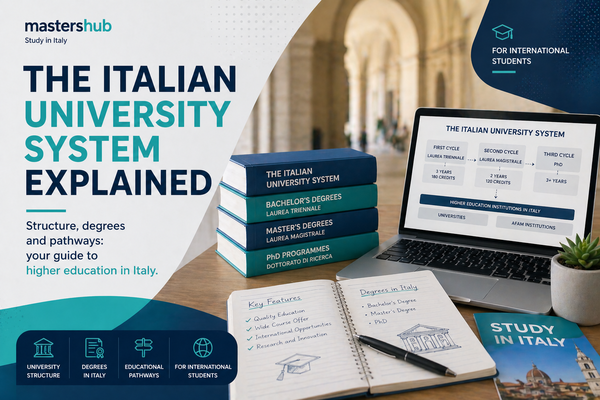
Today, Italy operates a rigorous, multi-cycle framework designed to ensure international mobility, quality assurance, and a seamless transition into the global labor market. This Italian university system explained serves as a definitive guide for students, parents, and academic consultants, detailing the institutional types, the nuances of the Bologna Process, and the specialized pathways that define one of the world’s most culturally and intellectually significant academic environments. By aligning its traditional rigor with the European Qualifications Framework (EQF), Italy offers a degree architecture that is both highly specialized and internationally recognized.
1. The Institutional Landscape: Understanding Where to Study
Navigating the Italian system begins with a strategic evaluation of the institutional landscape. In Italy, the choice of institution is not merely a matter of location but of pedagogical focus and professional alignment. The system is governed by the Ministry of University and Research (MUR), ensuring that all recognized institutions adhere to strict quality standards, regardless of their funding model.
The university-level landscape is categorized into four primary institutional pillars:
-
- State-run Public Universities: As the traditional backbone of the system, these are autonomous entities funded by the state. They offer the broadest range of disciplines and are typically the centers of large-scale scientific research and academic inquiry.
- Legally Recognized Non-state (Private) Universities: These institutions are privately managed but receive legal recognition from the MUR. They follow the same national regulations regarding degree structures and credit requirements, ensuring their qualifications are equivalent to those of public universities.
- Distance Learning Universities (E-learning): These are legally recognized non-state institutions that deliver curriculum primarily through digital platforms. While the delivery is flexible, the Italian regulatory framework mandates that all formal assessments must be conducted in person to maintain academic integrity.
- Specialized Superior Graduate Schools (Scuole Superiori Universitarie): These are elite, highly specialized institutions focused on high-level research and postgraduate training.
Legal Recognition and Parity
From a policy perspective, the most critical takeaway is the concept of “legal recognition.” In Italy, a degree’s validity is not determined by whether an institution is public or private, but by its accreditation by the MUR. This parity ensures that a Laurea from a private university carries the same legal weight as one from a state university for the purposes of public competitions (concorsi pubblici), professional licensure, and further academic study. However, the choice between them often hinges on specific factors: public universities typically offer lower, income-based tuition and broader research funding, while private universities may offer niche specializations and smaller class sizes.
2. The Architecture of Degrees: The Three-Cycle System
To grasp how university works in Italy, one must understand its commitment to the Bologna Process. This international agreement standardized higher education across Europe, introducing a credit-based system and a three-cycle degree structure. This alignment ensures that Italian degrees are mapped directly to the European Qualifications Framework (EQF), facilitating student mobility and the mutual recognition of qualifications.
First Cycle: Bachelor’s Degree (Laurea) – EQF Level 6
The Laurea is the foundational degree of the Italian system.
-
- Duration: 3 years of full-time study.
- Workload: 180 University Credits (CFU).
- Objectives: The pedagogical goal is to provide a solid grounding in general scientific methods while imparting specific professional knowledge.
- Academic Title: Upon completion, the graduate is awarded the title of Dottore.
Second Cycle: Master’s Degree (Laurea Magistrale) – EQF Level 7
The Laurea Magistrale represents advanced, specialized education.
-
- Duration: 2 years of full-time study.
- Workload: 120 University Credits (CFU).
- Objectives: This cycle focuses on high-level qualifications in complex fields and requires the defense of an original thesis.
- Academic Title: The graduate is awarded the title of Dottore Magistrale.
The Integrated Path: One-Cycle Degree (Laurea Magistrale a ciclo unico)
In specific fields, the Italian system departs from the 3+2 model in favor of an integrated path. These programs do not offer a mid-way exit point with a Bachelor’s degree; they are designed as a single, continuous journey toward a Master’s level qualification.
-
- Duration: 5 or 6 years.
- Workload: 300 CFU (5 years) or 360 CFU (6 years).
- Fields of Study: Reserved for EU-regulated professions, including Medicine, Dentistry, Architecture, Law, and others.
Regulatory Compliance and Professional Outcomes
The One-Cycle degree is a testament to the system’s rigor in training professionals for high-stakes sectors. By integrating the cycles, the Italian state ensures that students undergo a holistic, uninterrupted training process aligned with European Union standards.
3. Advanced Specialization and Research: The Third Cycle
The Third Cycle is the pinnacle of the Italian academic hierarchy, reserved for those who have completed a second-cycle degree. This stage is where the system branches into academic and vocational trajectories.
PhD (Dottorato di Ricerca) – EQF Level 8
The Doctorate is the highest level of academic degree, designed to produce researchers capable of advancing the frontiers of knowledge.
-
- Duration: Minimum of 3 years.
- Focus: Advanced scientific research methodology and the production of an original thesis.
- Access: Highly competitive, requiring a Master’s degree and an entrance examination.
Specializing Masters (Master di Primo e Secondo Livello)
It is vital to distinguish these from the Laurea Magistrale. These are vocational, “permanent training” courses.
-
- First Level Specializing Master: Requires a Laurea (Bachelor).
- Second Level Specializing Master: Requires a Laurea Magistrale (Master).
- Scope: Usually 1-year programs (60 credits) designed to provide specific professional skills.
Specialization Schools (Scuola di Specializzazione)
These are mandatory training paths for specific professions, particularly in healthcare, veterinary, and legal sectors.
Post-Graduate Training Courses (Corso di Perfezionamento)
A crucial nuance in the Italian system is the Post-graduate training Courses (Corso di Perfezionamento). Unlike the Specializing Masters, these are refresher courses that do not award a formal academic qualification but provide a certificate of acquired skills.
Academic Research vs. Vocational Expertise
The Third Cycle balances the needs of the “knowledge economy”. While the PhD drives innovation and theoretical advancement, the Specializing Master ensures the workforce remains agile and professionally competitive.
4. The Currency of Education: Credits and the Academic Framework
Central to the transparency of the Italian system is the credits system Italy ECTS protocol, which provides a quantitative measurement of student workload and ensures comparability across institutions.
The University Credit System (CFU)
The Credito Formativo Universitario (CFU) is the Italian implementation of the ECTS, measuring the total volume of learning based on defined outcomes and workload.
| Metric | Value |
|---|---|
| 1 CFU / ECTS | 25 Working Hours |
| Annual Workload | 60 CFU |
| 3-Year Total (Laurea) | 180 CFU |
| 2-Year Total (Master) | 120 CFU |
The workload encompasses all educational activities: attending lectures, laboratory work, internships, and individual study. One credit represents 25 hours of effort; therefore, an academic year of 60 CFUs corresponds to roughly 1,500 hours of total work.
The Academic Calendar and Workload Context
The academic calendar Italy university cycle typically runs from September/October to July. It is divided into two semesters, each followed by a dedicated examination period (sessione d’esame). A unique feature of the Italian system is the “appelli”—multiple opportunities to take an exam within a single session. This allows students to manage their 60-CFU annual workload with flexibility, though it requires strong self-discipline and time management.
International Mobility and Lifelong Learning
The CFU system acts as an “academic currency.” Because 1 CFU equals 1 ECTS, the system facilitates programs like Erasmus+ and other international exchanges with full transparency. Furthermore, it allows for the recognition of prior learning, meaning that professional skills or language certifications can be converted into CFUs, shortening the path to a degree and encouraging lifelong learning.
5. Alternative Higher Education: AFAM, SSML, and ITS
The Italian higher education system extends beyond traditional universities to include specialized sectors that are equally rigorous and legally recognized.
AFAM: The Artistic and Musical Powerhouse
The AFAM (Higher Education for Fine Arts, Music, and Dance) sector is comprised of 144 institutions, including:
-
- Academies of Fine Arts (State and private)
- Higher Schools of Design (ISIA): elite institutions focused on industrial and graphic design
- State Music Conservatories
- National Academy of Dance and National Academy of Dramatic Art
AFAM institutions award academic diplomas at the 1st and 2nd levels, equivalent to Bachelor’s and Master’s degrees. They use CFA credits, which operate identically to CFUs. Notably, restoration programs are structured as five-year One-Cycle degrees.
SSML: Higher Schools for Language Mediators
The SSML are specialized institutions offering three-year degrees (180 CFUs) equivalent to a Laurea in Language Mediation (Class L-12). They provide intensive multilingual training, preparing students for careers in translation and international communication.
ITS: Higher Technical Institutes
The ITS represent the non-university tertiary sector, designed in collaboration with small and medium-sized enterprises (SMEs) to address the skills gap in high-tech industries. They offer EQF Level V certifications (Diploma Tecnico Superiore) with a strong focus on practical and industry-driven innovation.
The Duality of the Italian Model
The coexistence of AFAM and ITS alongside universities reflects the duality of the Italian education system. On one side, universities provide a theoretical-scientific foundation for research and academia. On the other, AFAM and ITS deliver a theoretical-practical approach, supporting Italy’s global leadership in design, arts, and advanced manufacturing (Made in Italy). This diversity ensures that the system meets both academic and professional needs.
Frequently Asked Questions about the Italian University System
Here are the most common questions for international students who want to understand how universities in Italy, academic degrees, CFU credits and admissions work.
How does the university system work in Italy?
The Italian university system is based on a structured three-cycle framework overseen by the Ministry of University and Research (MUR). It follows the Bologna Process and is fully integrated into the European Higher Education Area. Students progress through the First Cycle (Laurea), Second Cycle (Laurea Magistrale) and Third Cycle programmes such as PhDs and specialization schools. Academic progress is measured through CFU credits, equivalent to ECTS.
How many years is university in Italy?
The duration of university studies in Italy depends on the degree path. A standard Bachelor’s degree, called Laurea, usually lasts 3 years and is followed by a Laurea Magistrale, equivalent to a Master’s degree, lasting 2 years. This is known as the 3+2 model. Some one-cycle degrees, such as Medicine, Law, Pharmacy, Architecture or Veterinary Medicine, last 5 or 6 years.
What is a Laurea in Italy?
A Laurea is the First-Cycle academic degree in Italy and is broadly equivalent to a Bachelor’s degree. It normally requires 180 CFU credits and takes 3 years to complete. After passing the final exam or dissertation, graduates receive the academic title of Dottore. The Laurea allows students to enter the job market or continue with a Laurea Magistrale.
What is a Laurea Magistrale in Italy?
A Laurea Magistrale is the Second-Cycle university degree in Italy and is equivalent to a Master’s degree in the international system. It usually lasts 2 years and requires 120 CFU credits. Students can access it after completing a Laurea or an equivalent foreign Bachelor’s degree. This degree provides advanced academic and professional specialization.
What are CFU credits in Italian universities?
CFU credits, or Crediti Formativi Universitari, measure the student workload in the Italian university system. One CFU usually corresponds to 25 hours of study, including lectures, seminars, laboratory work, internships and individual study. CFU credits are equivalent to ECTS credits, making Italian degrees easier to compare and recognize across Europe.
How can international students apply to university in Italy?
International students applying to universities in Italy usually need to check admission requirements, prepare academic documents and complete the application process through the university website. Non-EU students living outside Italy often also use Universitaly, the official MUR portal for pre-enrolment and visa-related procedures.
The Italian university system stands out for its clear, flexible, and internationally recognized structure. Thanks to its integration with the Bologna Process and the European Qualifications Framework, it offers pathways that combine academic rigor, international mobility, and career orientation, making it a strategic choice for both Italian and international students.
- Universitaly – The Italian Portal for University Orientation: The essential gateway for pre-enrollment and course databases.
- Ministry of University and Research (MUR): The primary regulatory body for all higher education in Italy.
- Tor Vergata University – International Students Section: A leading public institution providing detailed practical guides on the CFU system and admission for international applicants.