Procedure for studying in Italy:
Guide 2026 for International Students
Studying in Italy represents an extraordinary opportunity for thousands of international students who choose our country each year for the quality of education, its unique cultural heritage, and more affordable costs compared to other European and American destinations.

Requirements, visa, pre-enrollment, residence permit and practical advice for international students.
Whether you want to enroll in a bachelor’s degree, a master’s program, an English-taught course, or a university master, understanding the official procedure is essential to avoid mistakes and delays.
This complete guide accompanies you step by step: from choosing your program to pre-enrollment on Universitaly, from applying for the study visa to obtaining the residence permit, all the way to final enrollment.
It is a clear, updated, and practical reference point, designed to help you begin your academic journey in Italy with confidence and without uncertainty.
Procedure for studying in Italy as an International Student
Have you ever asked yourself how to study abroad in italy, here you can find a practical step-by-step guide that will hel you to reach your objective.
hide
Your content goes here. Edit or remove this text inline or in the module Content settings. You can also style every aspect of this content in the module Design settings and even apply custom CSS to this text in the module Advanced settings.
1. Understand if you meet the basic requirements
First of all, check:
Academic qualification
-
For a Bachelor’s degree (laurea triennale): a high school diploma valid for university admission in your country.
-
For a Master’s degree / postgraduate master: a first-level university degree or equivalent.
Length of studies: in general, your qualification must have a duration at least equal to what Italy requires (e.g., 12 years of schooling to access university).
Language: decide whether you want to study in Italian or English. You will need a language certification.
-
Italian: usually B2 level (CILS, CELI, PLIDA, CLIQ, certificates issued by universities for foreigners, etc.).
-
English: IELTS / TOEFL / Cambridge, typically B2 or C1, depending on the program.
If your qualification is unclear or you come from a very different education system, it may be helpful to request a Dichiarazione di Valore from the Italian Embassy or a CIMEA evaluation (for comparability of qualifications).
2. Choosing the program and the university
In Italy you can choose among:
-
Bachelor’s degree (Laurea triennale) – 3 years
-
Master’s degree (Laurea magistrale) – 2 years
-
Single-cycle programs (e.g., Medicine, Dentistry, Architecture, Law, etc.) – 5/6 years
-
University Masters of 1st and 2nd level – 1 or 2 years, postgraduate
-
English-taught programs – increasingly common, especially in business, engineering, sciences and international relations.
2.2. Criteria for choosing the university and the city
Consider:
-
Language of instruction (Italian/English)
-
Reputation of the university in your field
-
Cost of living in the city (Milan is more expensive than medium-small cities)
-
Services for international students (welcome office, tutors, language courses)
-
Internship and job opportunities in the area.
3. Check the specific requirements of the program
Every public, private or online university has its own rules. Always check the official website of the university or program:
-
Admission requirements (type of diploma or degree required, minimum grade, prior exams, etc.).
-
Entrance tests:
-
Programs with national restricted access (e.g., Medicine) → ministerial test.
-
Programs with locally restricted access → test organized by the university.
-
Open-access programs → usually only document verification.
-
-
Language level required and accepted certifications.
-
Deadlines for application, enrollment, and tuition payments.
4. Pre-enrollment on Universitaly (required for many non-EU students)
For many non-EU students living abroad, the key step is completing the procedure on Universitaly, the official pre-enrollment portal for Italian universities.
In short:
-
Register on the Universitaly portal.
-
Choose the program and the university among those available for international students.
-
Fill out the pre-enrollment application, including:
-
personal details,
-
academic qualification,
-
any language certificates,
-
ID document/passport.
-
-
Upload the required documents (in some cases translated and legalized).
-
Submit the application and wait for the university’s evaluation.
If the university approves, your pre-enrollment is validated, allowing you to proceed to the study visa phase.
Note: for EU students, the process is generally easier and often does not require a visa, although entrance tests or eligibility documents may still be required.
5. Prepare your academic documents
Prepare them in advance:
-
High school diploma or university degree (original).
-
Transcript of records and, if possible, detailed course syllabi (especially for master’s programs).
-
Official translation into Italian or English, if required.
-
Legalization / Apostille, depending on your country.
-
Dichiarazione di Valore issued by the Italian Embassy/Consulate or CIMEA evaluation, if needed.
These documents are required both by the university and, in many cases, by the Embassy for the study visa application.
6. University admission application
Each university has an online application portal. In general, you will need to:
-
Create an account on the university’s website.
-
Select the program you wish to apply for.
-
Fill out the application form with your personal details and academic background.
-
Upload the required documents:
-
passport,
-
diploma/degree,
-
transcript of records,
-
language certificate,
-
CV and motivation letter (especially for master’s programs).
-
-
Pay the application fee, if required.
-
Attend any admission tests or interviews (online or in person).
If you are accepted, the university will issue a letter of admission or a pre-enrollment declaration, both essential for the study visa process.
7. Apply for the study visa (type D)
If you are a non-EU citizen residing outside the EU, for stays longer than 90 days you will need the national study visa – type D, issued by the Italian Consulate/Embassy in your country.
7.1. Documents usually required
In general (requirements may vary by country):
-
Completed and signed visa application form
-
Valid passport (with at least 2 blank pages and validity covering the entire study period)
-
Passport-sized photo
-
Letter of admission / pre-enrollment from the Italian university
-
Proof of accommodation (rental contract, student residence, declaration of hospitality)
-
Health insurance valid in Italy
-
Proof of sufficient financial means:
-
bank balance,
-
scholarship,
-
financial support letter from a family member, etc.
-
-
Flight ticket (one-way) or reservation
-
Receipt of university fee payment, if required
7.2. Where and when to apply
-
At the Italian Consulate/Embassy responsible for your area of residence.
-
It is advisable to start the process several months before the beginning of classes (often between May and July for courses starting in September/October).
8. Arrive in Italy and apply for the residence permit
With the long-stay visa (type D), you can enter Italy. However, to live and study legally for more than 90 days, you must apply for the residence permit for study purposes.
8.1. Deadline to apply
Within 8 working days from your arrival in Italy.
8.2. Procedure (summary)
-
Pick up the “Yellow Kit” at an authorized Post Office (Sportello Amico).
-
Fill out the forms following the instructions (you can seek help from assistance centers or migrant support offices).
-
Attach the required documents:
-
copy of your passport and visa,
-
copy of your admission letter,
-
proof of enrollment or pre-enrollment,
-
proof of accommodation and financial means,
-
revenue stamp as required.
-
-
Pay the postal slips (permit issuance fee + administrative contribution).
-
Send the kit at the Post Office and receive the receipt with the appointment date at the Questura.
-
Attend the appointment at the Questura to:
-
submit any additional documents,
-
complete fingerprints and photo.
-
Then, wait for the issuance of the residence permit for study purposes, which will allow you to:
-
fully enroll in courses,
-
take exams,
-
work part-time within the limits allowed by law.
9. Final enrollment at the university
Once you arrive in Italy and have started the residence permit process, complete your university enrollment:
Submit to the student office, or upload online:
-
your diploma/degree (original and translation),
-
residence permit (or the receipt of your application),
-
tax code (codice fiscale) — you can request it at the Revenue Agency or via the Consulate before arrival,
-
any additional documents required by the university.
Pay the university fees by the indicated deadlines.
Activate your student account to:
-
register for exams,
-
access the library, e-learning platforms, institutional email, etc.
10. Housing, health insurance, and daily life
10.1. Housing
Most common options:
-
University residences
-
Rooms in shared apartments
-
Private rental accommodation
Search early, as demand is very high in major cities at the beginning of the academic year.
10.2. Health insurance
-
Non-EU students: private health insurance or enrollment in the Italian National Health Service (SSN) by paying an annual fee.
-
EU students: EHIC card (European Health Insurance Card) or other valid coverage.
11. Scholarships and financial aid
Many Italian regions and universities offer:
-
Reductions in university fees based on the ISEE or economic condition
-
Support for housing, dining, and transportation through Student Support Agencies (DSU, ERSU, etc.)
Always check:
-
Application deadlines
-
Required financial documents (also translated and legalized if needed)
-
Academic requirements (minimum number of CFU credits to earn each year)
12. Working while studying
With a residence permit for study purposes (non-EU students):
-
You may work part-time up to a maximum of 20 hours per week (with an annual limit on total hours).
-
The most common jobs are in hospitality, retail, services, and universities (tutoring, part-time collaborations).
Remember that work cannot be your main activity: your primary status remains that of a student.
13. After graduation: staying in Italy
Dopo la conclusione degli studi, esistono diverse possibilità, tra cui:
- Conversione del permesso di soggiorno per studio in lavoro se trovi un contratto idoneo
- Richiesta di permesso per ricerca di lavoro o imprenditorialità (nei limiti previsti dalla normativa vigente).
Le regole possono cambiare nel tempo, quindi è importante controllare sempre le indicazioni aggiornate sul sito del Ministero dell’Interno, del Ministero degli Affari Esteri e dell’università.
Services offered by Italian universities for incoming students: support with visa and residence permit procedures
Many Italian universities — especially private institutions — provide incoming students with a dedicated service to assist them with the bureaucratic procedures related to their arrival in Italy.
This support helps students navigate documents, deadlines and official requirements.
The service may include:
-
- Preparation of the invitation letter, required to apply for a visa (for non-EU students).
- Assistance with the visa application process for study purposes (for non-EU students).
- Support in applying for or renewing the residence permit for study reasons (for non-EU students).
- Guidance on health insurance and registration with the Italian National Health Service.
- Requesting the Italian Tax Code (Codice Fiscale).
- Registration with the local Municipality, when required (for EU students).
This service is usually managed by the Orientation, Tutoring or International Relations offices, which also organise webinars, information meetings and 1:1 online sessions.
It is important to remember that university admission does not automatically guarantee the issuance of a visa.
The final decision rests solely with the Italian diplomatic and consular authorities.
Riepilogo in 10 passi
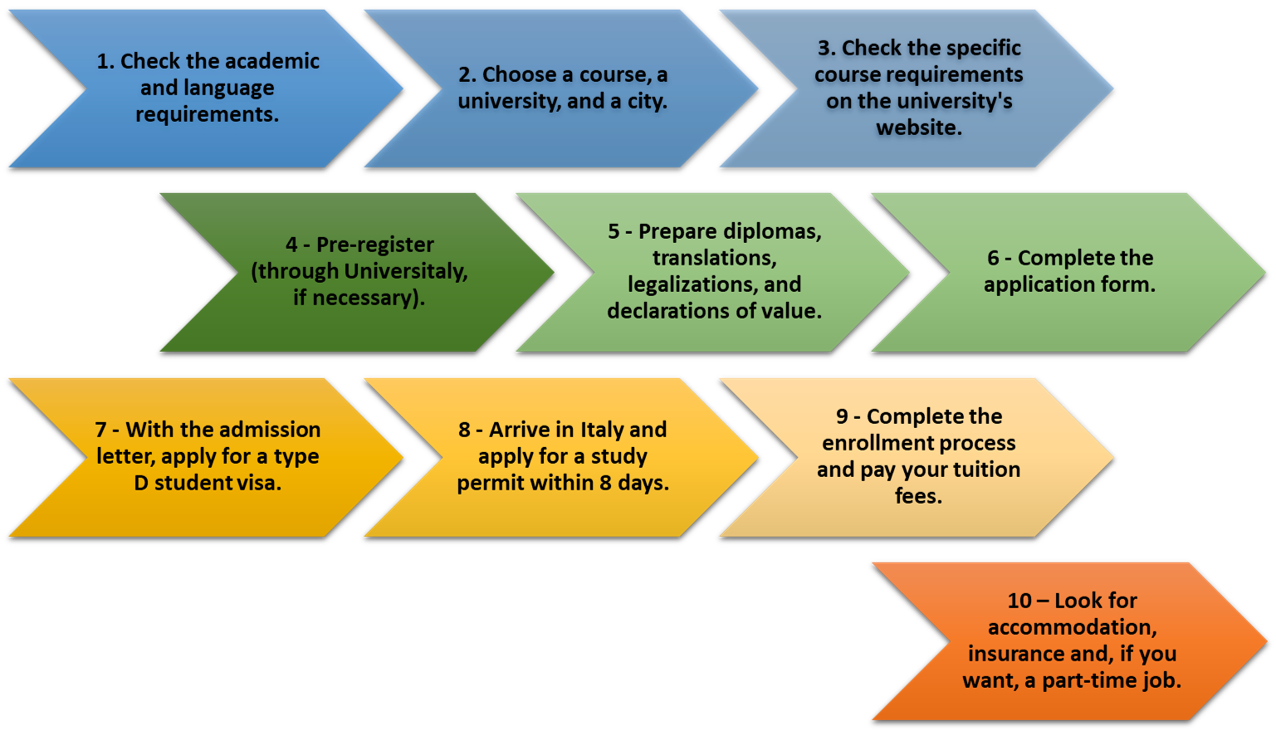
Studying in Italy in 2026 is a path full of opportunities, but it requires attention, organization, and knowledge of the official procedures. With the right documents, proper planning, and a clear understanding of each step—from admission to visa, and from residence permit to enrollment—you can build a strong and rewarding academic experience.
Italian universities offer programs in Italian and English, a growing international environment, and many opportunities for professional development. Prepare carefully, follow the steps provided, and start your future in the heart of Europe. Italy is waiting for you.