Admissions to Private Universities in Italy
Healthcare for international students in Italy is one of the most important things to arrange before starting an academic journey in Italy. Beyond university enrollment, the visa, and accommodation, it is essential to understand how healthcare works for foreign students in Italy and what legal obligations apply.
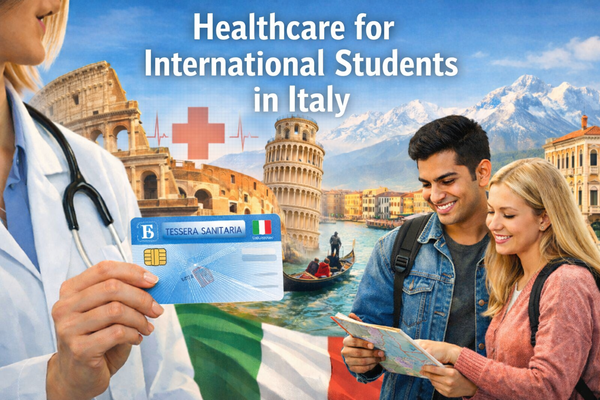
Italy has a high-quality public healthcare system, the National Health Service (SSN), which provides medical care throughout the country. However, access rules vary depending on the student’s origin (EU or non-EU) and the length of stay.
Studying in Italy is an extraordinary opportunity. Doing so with adequate health coverage means enjoying the experience with complete peace of mind.
How healthcare works for international students in Italy
The Italian healthcare system is public and universal. The National Health Service (SSN) guarantees access to medical care for Italian citizens and for foreigners who are legally residing in the country.
Regarding healthcare for international students, you are required to prove valid health insurance coverage in order to:
-
Obtain a study visa
-
Apply for a residence permit
-
Stay in Italy for the entire duration of your course
The main options are:
-
Voluntary enrollment in the SSN
-
Private health insurance valid in Italy
Official information is available on the Italian Ministry of Health website.
Healthcare for EU international students: what to know about the TEAM
Students from European Union countries can use the European Health Insurance Card (EHIC).
The EHIC allows you to receive medically necessary care during a temporary stay in Italy, under the same conditions as Italian citizens.
What does the EHIC cover?
-
Urgent care
-
Hospital admissions
-
Access to the emergency room
-
Non-deferrable medical assistance
The EHIC does not cover planned treatments or private healthcare.
If an EU student moves to Italy for a long period (over 90 days), they may consider voluntary enrollment in the SSN for more comprehensive coverage.
Healthcare for non-EU international students: obligations and solutions
For non-EU students, the regulations are stricter. To obtain a residence permit for study purposes, it is necessary to prove that you have health coverage for foreign students in Italy that is valid and recognized.
-
Private health insurance for foreign students
-
Voluntary enrollment in the National Health Service (SSN)
Private health insurance for foreign students
Many students choose an international health insurance policy before departure.
The health insurance must:
-
Be valid in Italy
-
Cover hospitalizations and urgent care
-
Cover the entire period of stay
However, not all policies are accepted for the issuance of the residence permit. It is important to check with the Italian consulate in your country.
Voluntary enrollment in the National Health Service (SSN)
Enrollment in the SSN is often the most advantageous choice for those studying in Italy for several months or years.
According to the official guidelines of the Ministry of the Interior, students can enroll voluntarily in the SSN by paying an annual fee.
Advantages of enrolling in the SSN:
-
Assigned general practitioner
-
Full access to public hospitals
-
Specialist visits with a reduced co-payment
-
Coverage throughout the national territory
-
Continuous care
The annual fee is generally between 150 and 200 euros, varying by region.
For long stays, enrolling in the SSN is often the safest and most cost-effective solution.
Public or private healthcare: which is better for international students?
| Feature | Public healthcare (SSN) | Private healthcare |
|---|---|---|
| Healthcare coverage | ✔ Full coverage | ✖ Variable coverage |
| Costs | ✔ Lower costs | ✖ Higher costs |
| Continuity of care | ✔ Assigned GP and continuous care | ✖ Not always guaranteed |
| Waiting times | ✖ Sometimes long | ✔ Generally fast |
| Facilities | ✔ Public hospitals widely available across the country | ✔ Modern facilities and personalized services |
Vaccinations and health prevention for international students
Some university programs, especially in the healthcare field, require vaccination certificates.
It is recommended to:
-
Check your vaccination status before departure
-
Bring translated medical documentation
-
Ask your university for information
Prevention is a key element of healthcare for international students in Italy.
Psychological support and mental well-being
Studying abroad can cause stress, homesickness, or adjustment difficulties.
Many Italian universities offer:
-
Free psychological counseling
-
Support in English
-
Guidance and orientation services
Mental health is an integral part of healthcare support for international students.
Studying in Italy with safe healthcare
Healthcare for international students in Italy is a fundamental topic for anyone who wants to enjoy a peaceful and protected academic experience. Whether you come from the European Union or a non-EU country, it is essential to plan your health coverage in advance.
Registering with the SSN is often the most complete and affordable solution, while private insurance can be useful for short stays or specific needs.
Good healthcare planning allows you to focus on what really matters: your study path and personal growth.
Health is your most important investment. Protect it, stay informed, and make the most of your university experience in Italy.
FAQ – Frequently asked questions about healthcare for international students
hide
hide
1. Is health insurance mandatory for a visa?
Yes, it is mandatory to obtain a visa and a residence permit.
2. Can I use the EHIC for an entire degree program?
The EHIC covers temporary stays. For long-term stays, the SSN is recommended.
3. How much does SSN enrollment cost?
About €150–€200 per year.
4. Is the emergency room always free?
Yes for real emergencies; non-urgent cases may require a co-payment (ticket).
5. Can I choose my general practitioner (GP)?
Yes, among those available at your local ASL.
6. Does healthcare cover medications?
Yes, but some may require a co-payment (ticket).